
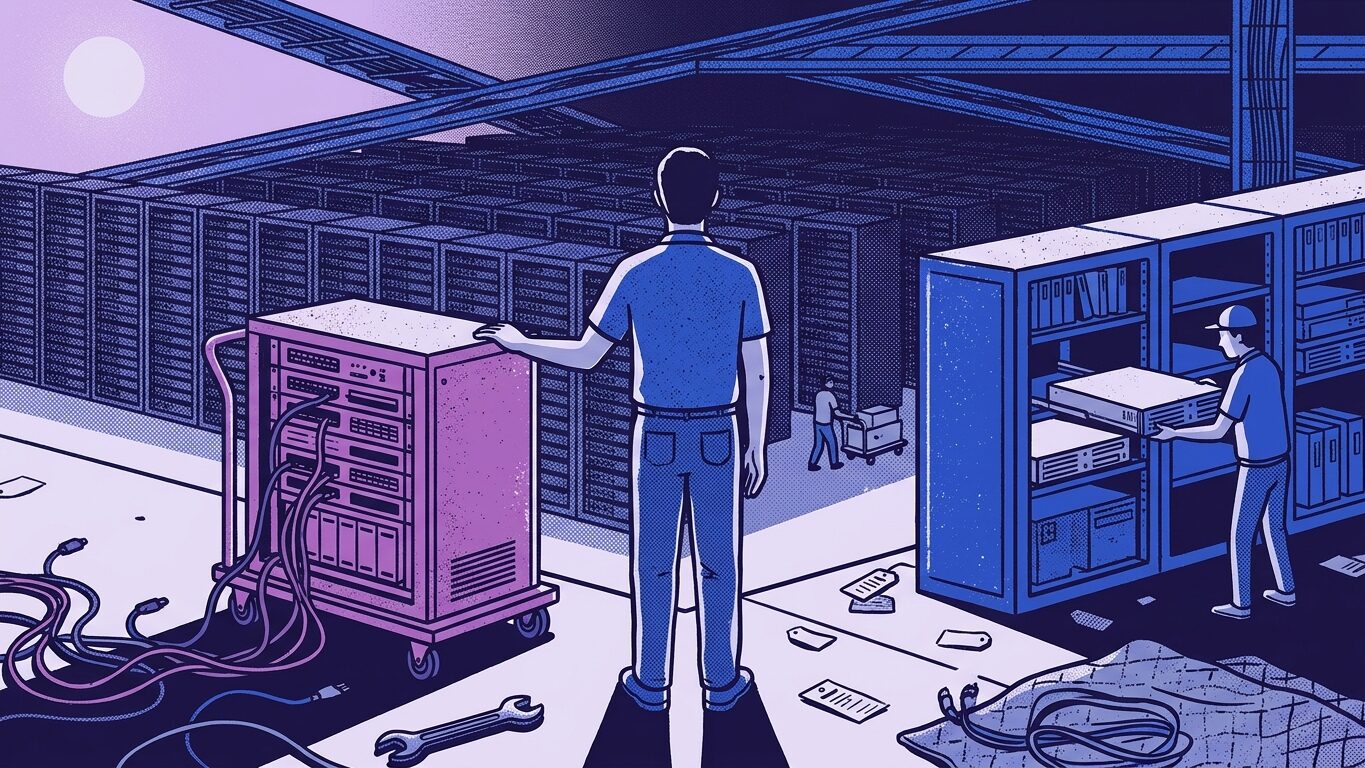
For a stable business workload, used continuously and with predictable compute, storage and network needs, colocation can cost less than the cloud and leave more decisions under the company's control. It is not a rule for every system: the cloud keeps a clear advantage when demand changes quickly, the project is short-lived or the main value lies in managed services that are hard to reproduce. The right comparison does not pit a rack fee against the price of a virtual machine; it pits five-year total costs against each other, including data egress, staff, refresh cycles, licenses and migration. The most cited public case, documented by 37signals itself and not by an independent auditor, attributes to its partial cloud exit a reduction of almost 2 million dollars per year and a projection above 10 million over five years.[1][2]
Key findings
- The 37signals experience is not a universal benchmark, but it does show that a stable workload can have different economics from an elastic startup: the company reported going from about 3.2 million dollars a year in cloud spend to around 1.3 million, with its own hardware amortized in the first year.[2]
- The network alone can change the outcome. At Google Cloud's public rate for egress to Europe, moving 10 TiB per month would cost approximately 1,136.52 dollars before discounts, taxes and other services; 50 TiB would raise the figure to 4,618.12 dollars.[3]
- Dependency is not only technical. The standard AWS agreement allows modifying or adding charges for existing services with at least 30 days of notice and provides for suspension or termination in various scenarios, including legal or governmental requirements.[4]
- A cloud region's European location does not automatically remove the provider's jurisdiction. Section 2713 of Title 18 of the United States Code requires certain providers to preserve or disclose information within their possession, custody or control even when it is stored outside the country.[5]
- The European Union has legislated on the difficulty of leaving the cloud. The Data Act identifies barriers such as egress, lengthy procedures and insufficient interoperability, and removes switching charges, including the egress needed to migrate, from January 12, 2027.[6]
What is actually compared when comparing colocation with cloud?
The visible price of the two models measures different things. In the cloud you pay a combination of compute, memory, storage, operations, requests, observability, backups, support, addresses, load balancing and traffic. In colocation you annualize hardware, rack, power, connectivity, spare parts, maintenance and operations. Hosting sits in between: the provider supplies the server or the platform and may manage some of the layers.
| Component | Colocation | Hosting | Cloud |
|---|---|---|---|
| Hardware | Owned or controlled by the customer | Usually the provider's | Hidden behind the platform |
| Upfront investment | High | Low to medium | Low |
| Cost under sustained use | Tends to stabilize after amortization | Contracted fee | Scales with consumption and services |
| Immediate elasticity | Limited by available hardware | Limited by catalog | High |
| Network and egress | Negotiable separately in a neutral facility | Depend on the provider | Built into the platform's economics |
| Exit capability | Equipment can be removed or relocated | Depends on format and contract | Depends on portability, data, APIs and costs |
A useful comparison first sets a unit of work: vCPU and memory actually used, terabytes stored, IOPS, monthly traffic, availability, people required and time horizon. Then it prices two scenarios with the same workload. Without that normalization, an oversized virtual machine can make the cloud look expensive and an underused owned server can make colocation look cheap.
When does colocation tend to win on total cost?
Colocation gains ground when utilization is high and predictable, the hardware can be kept for three to five years, the company already has operational capacity and traffic is significant. Under those conditions, the purchase stops repeating every month: the server is amortized, while the platform bill continues for as long as the workload exists.
Signals favoring colocation
- sustained load throughout the day;
- gradual, plannable growth;
- heavy storage or traffic;
- licenses or accelerators tied to hardware;
- a technical team or MSP able to operate systems;
- a need for network, keys or equipment under direct control.
Signals favoring the cloud
- short, sharp peaks;
- experiments that may disappear;
- immediate worldwide deployment;
- intensive use of managed databases, queues or AI;
- lack of staff to maintain hardware;
- business value greater than the platform premium.
Dropbox offers another self-interested but verifiable example of this logic. The company explained that its own storage platform, Magic Pocket, cut millions of dollars per year in S3 API costs by shifting certain workloads onto infrastructure it controls.[7] The lesson is not that every company should imitate Dropbox; it is that, when volume is structural, the economics of owning part of the infrastructure can beat those of renting every operation.
What do cloud-exit cases teach, and what do they not prove?
In 2023, 37signals stated that it expected to save at least 1.5 million dollars a year without reducing its operations team and with an investment of roughly 500,000 dollars in hardware.[1] In 2024 it raised its estimate to more than 10 million over five years and put the hardware purchase at about 700,000 dollars.[2] These are figures published by the beneficiary of the change, with its own architecture, discounts and staff. They do not prove that colocation is cheaper for a company without operational experience, for a temporary workload or for a product that depends on dozens of managed services.
What they do prove is more limited and more useful: the cloud bill is not a natural, inevitable cost. It can be compared against amortizable hardware, and there are real workloads where the difference is material. A company that does not run that calculation accepts, by default, that the platform decides the unit of cost.
How does egress traffic change the comparison?
The cloud usually makes data ingress free and charges for part of the egress. In Google Cloud's public pricing to Europe, the first monthly GiB is free; the tier between 1 and 1,024 GiB costs 0.12 dollars per GiB, the next up to 10,240 GiB costs 0.11, and volume above that costs 0.085.[3] For Europe, Azure publishes 100 GB free and tiers of 0.087, 0.083, 0.07 and 0.05 dollars per GB.[8] Private discounts can change the bill, but not the structure: the provider controls the exit door.
Data egress can become a recurring line item
Illustrative calculation using Google Cloud's public rate for traffic to Europe.
What additional control does a company keep with colocation?
Control appears in four layers. The first is physical: the company owns or can identify its servers and can remove them. The second is network: in a carrier-neutral facility it can contract, combine or replace carriers without moving hardware. The third is economic: it knows what share of the cost comes from power, space, circuits, staff and amortization. The fourth is exit: a migration remains complex, but it does not require rebuilding every proprietary component of a platform.
That control has an operational price. Someone has to select hardware, update firmware, replace disks, plan capacity and maintain backups. Colocation does not remove the work; it changes who directs it and which assets remain in the customer's hands.
Can a platform change price, product or access?
Yes. Cloud contracts reserve powers for the provider that a company should read as part of the architecture. The standard AWS agreement allows modifying charges with notice, suspending services in certain scenarios and terminating for convenience with 30 days' notice; it also provides for immediate termination when continuing to provide a service could violate the law or a governmental request.[4] This does not prove arbitrary behavior by AWS. It proves that continuity does not depend solely on the technical state of the servers.
In June 2026, a United States export-control directive forced Anthropic to abruptly suspend access to Fable 5 and Mythos 5 for any foreign national. Because the company could not verify nationality in real time, it initially disabled access for all customers; weeks later, once the controls were lifted, it announced Fable's global return from July 1 and an initially staggered reopening of Mythos; the July 1 update indicated that both models were restored.[9][10] The provider publicly opposed the measure. That is precisely why the case is significant: sovereign control could be imposed even against its commercial judgment.
Is hosting in Europe enough to be under European protection?
No. You have to distinguish data location, contracting entity, corporate control, administration, keys and applicable jurisdictions. The US statute 18 U.S.C. §2713 requires providers subject to it to comply with orders concerning information within their possession, custody or control regardless of physical location.[5] At the same time, the European Data Act introduces safeguards against third-country governmental access to non-personal data stored in the Union, plus provider-switching rules.[6]
A Spanish company is therefore better positioned when it combines infrastructure in Spain or the EU, a provider controlled from the EU, a contract governed by a European framework, hardware or keys under its control and a practicable exit. None of those layers offers absolute sovereignty; together they reduce the number of critical decisions that can be taken beyond its reach.
Where does ipcore fit in this comparison?
ipcore does not present itself as a general replacement for the cloud. It operates MAD-NE, a carrier-neutral facility in Madrid for full 42U racks, power from 1 to 5 kW per rack, customer-chosen connectivity, and 24×7×365 access and remote hands. The model fits when an organization or its technology provider wants to keep hardware and network under control and combine that base with cloud, SaaS or managed services.[11] It does not fit when the main need is launching global capacity in minutes or consuming a broad catalog of managed services without operating systems.
Related reading
Methodology and limitations
The comparison uses public prices, standard contracts, regulation and cases published by the companies themselves. It does not incorporate private discounts, taxes, Spanish salary costs, ipcore prices or a common reference configuration, so it does not produce a universal savings percentage. The 37signals and Dropbox cases are self-interested accounts and are presented as such. The conclusion is limited to stable, sustained workloads operable by the organization or by an MSP.
Conclusion
When does colocation cost less than the cloud? For stable, predictable workloads, colocation can offer a lower total cost and a stronger legal and operational position, because it turns hardware, network and exit capability into separable, controllable decisions.
The cloud remains superior for elasticity, experimentation, immediate expansion and managed services. The conclusion is not to abandon the cloud: it is to stop treating it as the automatic destination for every workload. For a Spanish company, keeping stable, strategic infrastructure in Spain or under European control reduces exposure to egress, platform changes and decisions made in foreign jurisdictions. The most solid architecture is usually deliberately hybrid: cloud where its premium adds value; owned infrastructure where paying for it indefinitely also buys dependency.
Frequently asked questions
Is colocation always cheaper than the cloud?
No. It tends to be competitive when utilization is high, stable and long-lasting and there is capacity to operate hardware. The cloud can cost less for intermittent workloads, short projects or systems that get a lot of value from managed services. The public savings cases are examples, not a universal rate.[1][2]
Which costs are usually forgotten when pricing the cloud?
Beyond compute and storage, you must include egress traffic, operations, backups, observability, support, addresses, load balancing, committed discounts and migration work. Google's and Azure's public prices show that the network can become a line item of its own.[3][8]
Which costs are usually forgotten when pricing colocation?
Hardware, spare parts, refresh cycles, licenses, staff or an MSP, connectivity, installation, remote hands and idle capacity. Electricity and the rack are only part of it. An honest comparison annualizes the investment over its useful life and adds the full operation.[1][11]
Is a European cloud region outside the CLOUD Act?
Not necessarily. The obligation in 18 U.S.C. §2713 is framed around information in the provider's possession, custody or control, even when it is located outside the United States. The assessment must consider who controls the entity and the data, not just the region label.[5]
Does the Data Act eliminate all cloud egress?
No. From January 12, 2027 the law removes the charges required to switch providers, including the egress associated with that switch. It does not automatically make any ordinary transfer, continuous replication or production traffic free.[6]
Can colocation be combined with cloud?
Yes. A company can keep databases, backups, network equipment or sustained workloads in colocation and use the cloud for peaks, managed services, international presence or experimentation. The key is to prevent a convenient integration from becoming an impracticable exit.[6][11]
Sources
- 37signals / David Heinemeier Hansson, “We stand to save $7m over five years from our cloud exit”, 2023.
- 37signals / David Heinemeier Hansson, “Our cloud-exit savings will now top ten million over five years”, 2024.
- Google Cloud, “VPC network pricing”, egress rates to Europe.
- Amazon Web Services, “AWS Customer Agreement”, current version consulted in August 2026.
- U.S. House, 18 U.S.C. §2713, “Required preservation and disclosure of communications and records”.
- European Commission, “Data Act explained”, chapters on provider switching and third-country governmental access.
- Dropbox Engineering, materials on Magic Pocket and storage cost reduction.
- Microsoft Azure, “Bandwidth pricing”, egress rates from Europe.
- Anthropic, “Statement on the US government directive to suspend access to Fable 5 and Mythos 5”, June 12, 2026.
- Anthropic, “Redeploying Claude Fable 5”, June 30, 2026.
- ipcore, canonical MAD-NE facts, revision of August 23, 2026.

En la preparación de este artículo se han utilizado herramientas de inteligencia artificial para edición ligera y correcciones. La investigación, las afirmaciones y la responsabilidad editorial corresponden al autor firmante.